Personal productivity
Sticky Day
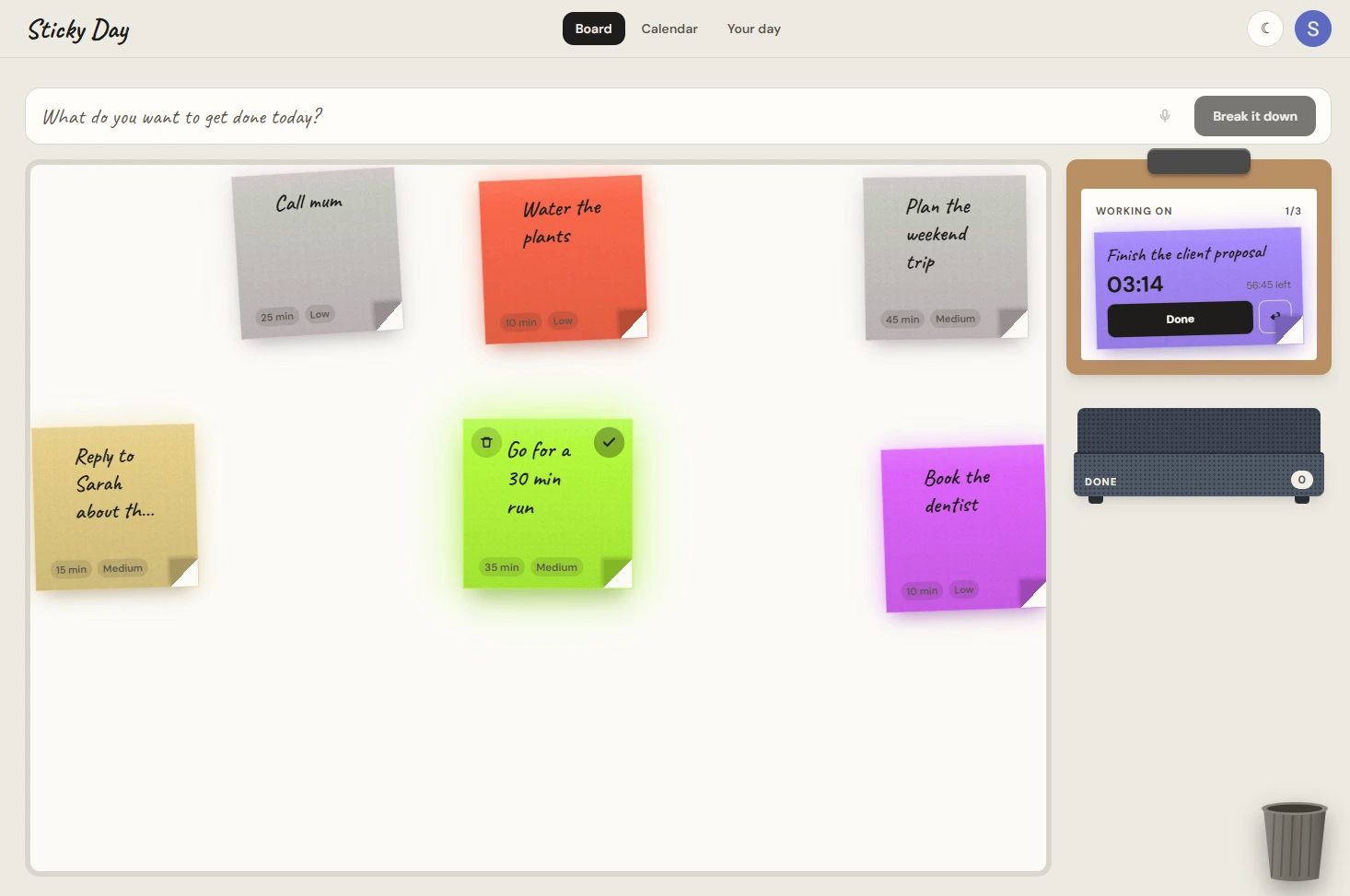
A whiteboard for your day: type what you want to get done, AI turns it into sticky notes, and at the end of the day the app writes you a short note about how it went.
- Client
- Gidev Innovations (own product, open source)
- Sector
- Personal productivity
- Year
- 2026
- Stack
- Next.js, TypeScript, Supabase, Postgres / RLS, Vercel AI SDK, Gemini / Groq, Tailwind, Framer Motion
The problem
Most planners ask you to structure your day before you've thought about it — fields, priorities, due dates — and then report on it like a manager. People who think in sentences, not forms, end up with a to-do app they stop opening. There was also no low-cost way to learn what it takes to run a real AI feature in production: prompt design, model fallback, cost caps, privacy.
What we did
We built Sticky Day as a single-page board: one text box takes a plain-language brain dump and a language model splits it into notes with a rough time and energy level; notes are dragged to a clipboard to work on with a timer, to a tray when done, or to a restorable bin. Unfinished notes roll over to tomorrow. At a time the user chooses, in their own timezone, the app writes an end-of-day page in a warm, non-corporate voice on a rotating theme, with no minutes or scores. Every model answer is validated against a schema before it touches anything; the app does its own arithmetic. Models run in a fallback chain across Gemini and Groq free tiers, with per-account daily caps, row-level security in Postgres, and a privacy page that states plainly what the providers' free-tier terms allow.
Outcome
Version 1 is live at sticky-day.vercel.app with Google sign-in and three pages — board, calendar, your day. The code is open source with a self-hosting guide, so anyone can run it on their own keys. It is in daily use by its author; no usage metrics are published yet.